
For Children with Autism, Pinellas Pool’s Swim Lessons Aim to Save Lives
Natanya Friedheim | Tampa Bay Times
Jun 25, 2026
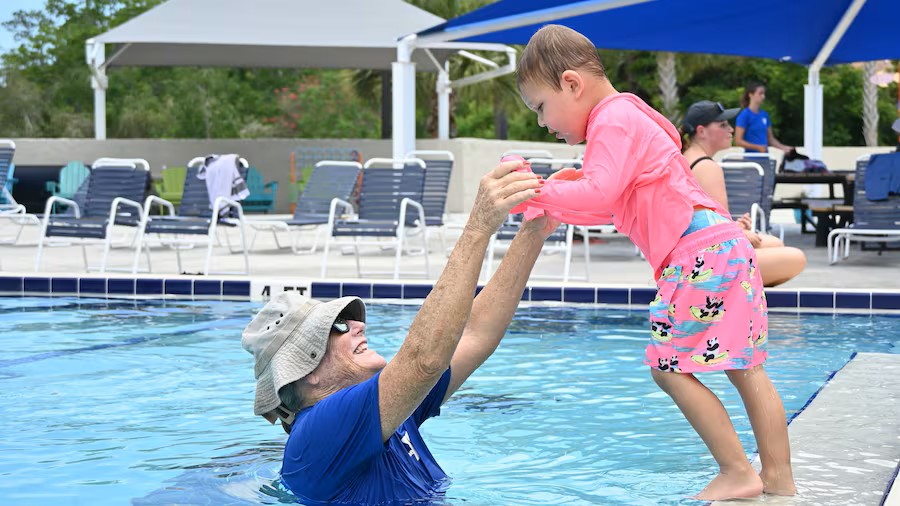
The sliding glass door leading to Natasha Lim’s backyard pool has a lock and an alarm. A fence around the pool also has a lock, plus a bungee cord to thwart curious fingers.
Kids with autism are drawn to water, and Lim’s son Blake, 5, is no exception.
The water is soothing. It is quiet underneath.
“If he gets a chance, he’ll just go to the bottom and stay there,” Lim said as she watched her son bob up, open his mouth for air, then duck back under the water at the John Geigle YMCA pool on Wednesday afternoon in Palm Harbor.
This week, for the first time, the YMCA offered four days of free adaptive swimming lessons to children with disabilities and their families, through funding from the Pinellas Juvenile Welfare Board.
Parents of children with special needs looking for swim lessons have few options in Pinellas County, Lim said. When she took her son to an indoor pool, he cried the entire time. The noise overwhelmed Blake, who usually wears noise-reducing earmuffs or keeps his hands pressed over his ears.
Here at the YMCA’s outdoor pool, Blake leaves his earmuffs on the pool deck as a swim instructor guides his arms in a front crawl stroke.
Fifty-eight children have drowned in Florida so far this year. From 2022 to 2025, drowning fatalities increased from 94 to 120, according to data from the Florida Department of Children and Families. And a 2017 study from the Columbia University Mailman School of Public Health found that autistic children are 160 times more likely to die from drowning compared to other children.
“We just want to save lives,” said Mindy Taylor, the Juvenile Welfare Board’s child safety and prevention initiative lead.
The board invests $100,000 a year to provide swim lessons for about 2,500 children. This year, Taylor is working with Pinellas County pools to offer adaptive swim instructor certification courses so more instructors are trained to teach children with disabilities.
Blake loves pools, ponds and bathtubs. He also elopes, a word describing autistic children’s tendency to wander.
Every time Lim takes Blake on a walk, they retrace their steps on the same path in the hope that if Blake elopes, he will remember which route to take. His parents and first responders would know where to look.
Blake is nonverbal and does not respond when someone calls his name.
“Anywhere he is, if he gets out, the first thing he’s going to do is try to go to water,” Lim said.
The dangers are obvious. Last spring, a 3-year-old boy who was autistic and nonverbal wandered out of his apartment in Palm Harbor. He walked to one of the many ponds that speckle the community and drowned.
The shallow end of the YMCA pool is still at least a foot taller than Blake. On Wednesday, he used the pool floor like a trampoline, crouching down and springing to the surface for air before plunging again below the surface.
During the adaptive swim lessons, children first learn to float. Then comes the elementary backstroke, followed by the regular backstroke.
“We want to give them those survival skills first,” said Taylor Dickson, aquatics director at the John Geigle YMCA. If a child falls in, she said, they can maintain their float and move to the side of the pool.
After wading closer to the deep end, Blake grabbed the concrete ledge.
“Elbow, elbow, knee, knee,” Sharon Beckler, a swim instructor, chanted as Blake hoisted himself on a shallow platform next to the pool deck. Pool water poured out of his open mouth. Back on the ledge, he tapped his fingers together — sign language for “more.”
“I know you want more,” Beckler said, prompting him to wait until she finished singing “Humpty Dumpty.”
Blake launched back into the water belly first and made his way to the floating lane dividers, but Beckler steered him back to the ledge.
“The goal is to get muscle memory so if they fall in, they know they can get back to the wall,” she said.
Blake’s mother spends hours in the car shuttling her son to and from Tampa for occupational therapy, feeding therapy and speech therapy. This YMCA is less than five minutes from her house.
Because he is nonverbal, Blake cannot share with his mother how the water makes him feel. She imagines it feels like serenity, she said, like the most peace her son has felt in his life.
Read the story as originally published at https://www.tampabay.com/news/pinellas/2026/06/25/swim-lessons-autistic-children/